
A cock feathered like a hen is the easiest thing in the yard to recognize and the hardest to trace. Wales, Spain, Mexico, India — every old book starts him somewhere different, and every one of them was sure.
Beamology CNC · families & Bloodlines
A Henny is a cock that feathers like a hen. No sickles. Short, round-tipped hackle and saddle feathers. A tail carried the way a hen carries hers. Everything else about him is cock — the comb, the spurs, the station, the crow.
Ask where that came from and you will get a confident answer. England, somebody will tell you. Ask again somewhere else and you will hear Spain, or Mexico, or India, just as confidently.
That is not a modern problem. It was already true in 1869, when Dr. J. W. Cooper found two different fowl being sold in America under nearly the same name and trusted only one of them. It was still true in 1929, when C. A. Finsterbusch wrote that the Hennies “have always been a matter of controversy among game savants.”
The old books do not agree on where the Henny started. They do not agree on what he should weigh. They do not even agree on whether he is a family at all, or a feather that turns up in other families.
What follows is what each of them actually said, oldest first, laid beside each other — and then what the feather itself turned out to be.
The earliest firm date anyone has put on a Henny is 1670.
It comes from Atkinson’s The Old English Game Fowl, published in London in 1891. Atkinson did not write the Henny chapter himself. He said it came “from the pen of the greatest breeder of that variety at the present time,” and his preface thanks a writer who signed himself only “Game Cock.” They are very likely the same man. His real name is never given.
That man wrote that the Hennies “were formerly very plentiful in Wales and Cornwall,” and he gave the oldest dated record he knew:
“an old account of a main, fought at Pontefract in the year 1670, hen-cocks v. long-feathers.”
— “Game Cock,” in Atkinson, 1891
Hold onto that date. Nothing sourced goes further back.
Notice what the record actually says, though. Hen-cocks against long-feathers means the hen-cock was already a known kind of fowl in 1670 — established enough to be set against the others as a side of its own. That is the kind of date that marks when somebody wrote it down, not when it started.
Then the line that tells you how they were regarded:
“The black hen-cocks of Wales were thought a fit present for a prince, and Pembrokeshire once challenged all England with them.”
— “Game Cock,” in Atkinson, 1891
He named one more man, known only as Hunt, who brought “these black-thornes (hen-cocks)” into Somersetshire. And he passed along what the old men of that country used to tell — that “when there were no roads for carriages, they carried their hen-cocks on horseback to Exeter.”
The illustration that went with the chapter is a grouse-colored hencock, “the property of Mr. John Harris, Liskeard,” a Cornish town. Wales, Cornwall, Somerset, Devon. The Henny country was the far west of Britain.
Ireland had them too. In Cooper’s 1869 book, Marshall Wheeler, Esq. described the Irish Henfeathers, “so called, because the cocks have tails short, like a hen,” and noted how the colors could break: “a brown red cock might turn out a spangled, a gull or a white.” Worth knowing before you cull something over color. Color was not what made a Henny, even then.
By 1878 the family was known by name on this side of the water. Gray’s Cocker’s Manual (Battle Creek, Michigan) listed the Cornish Hennies in the same breath as the Cumberland Muffs, the Isle of Wight Yellows and the Devonshire Tassels.
The man who wrote the 1891 chapter looked east himself. The Ceylon jungle fowl, “being partly hen-feathered, suggests itself as a likely ancestor,” he wrote, and “Gilbert and other officers have seen henny-cocks fought in India.”
Then he argued against his own idea, in the next breath:
“On the other hand we had game fowls long before having any intercourse with that country.”
— “Game Cock,” in Atkinson, 1891
That is the best-regarded Henny breeder in England raising the eastern theory and then refusing to lean on it. It is worth reading him the way he read himself.
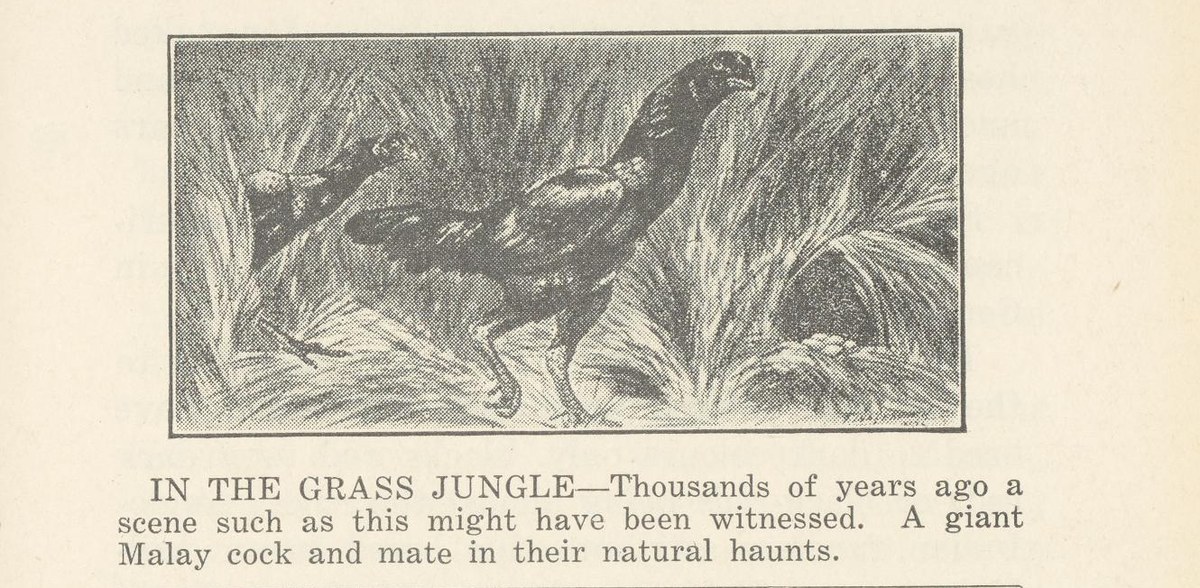
Page 239, Histories of Game Strains, 1928 · Cornell University Library
The 1928 Histories of Game Strains handed the Asian games to a writer who had handled a great many Calcuttas. Of the Malays, he wrote: “Apparently their ancestors were henny feathered or nearly so.” South India, he said, had a well-known breed, Malay in type, that carried the henny feather. The name for it came from the local word for a hen, kikili, “and thus the cocks are named Kikilia or hennies.” Among the Haiderabadi fowl, he added, henny specimens “are not at all seldom.”
Finsterbusch, in 1929, took up the other side of the old argument. Some writers had called the Hennies “rank degenerations.” He would not have it. He described them as “reputed for very strong spurs,” with “many intrinsic qualities among which speed ranks highest,” at 7 to 9 pounds. And this is the part to read slowly:
“It is much more plausible that the henny character of some fowl is due to ancestral crossing.”
— C. A. Finsterbusch, 1929
Crossing with what, he named: the slender Singapore game fowl, and “the Henny Malay of Ceylon, the ‘Kikilia’ which is still to be seen there.” He wrote that “the dash of blood has been extremely diluted in the course of centuries,” and that the feather could be found among the Madras and Rampur fowl as well.
Spain had its own words for it. The full-feathered cock, Finsterbusch wrote, was the Gallo Real. The henny one was the Gallo Gallino.
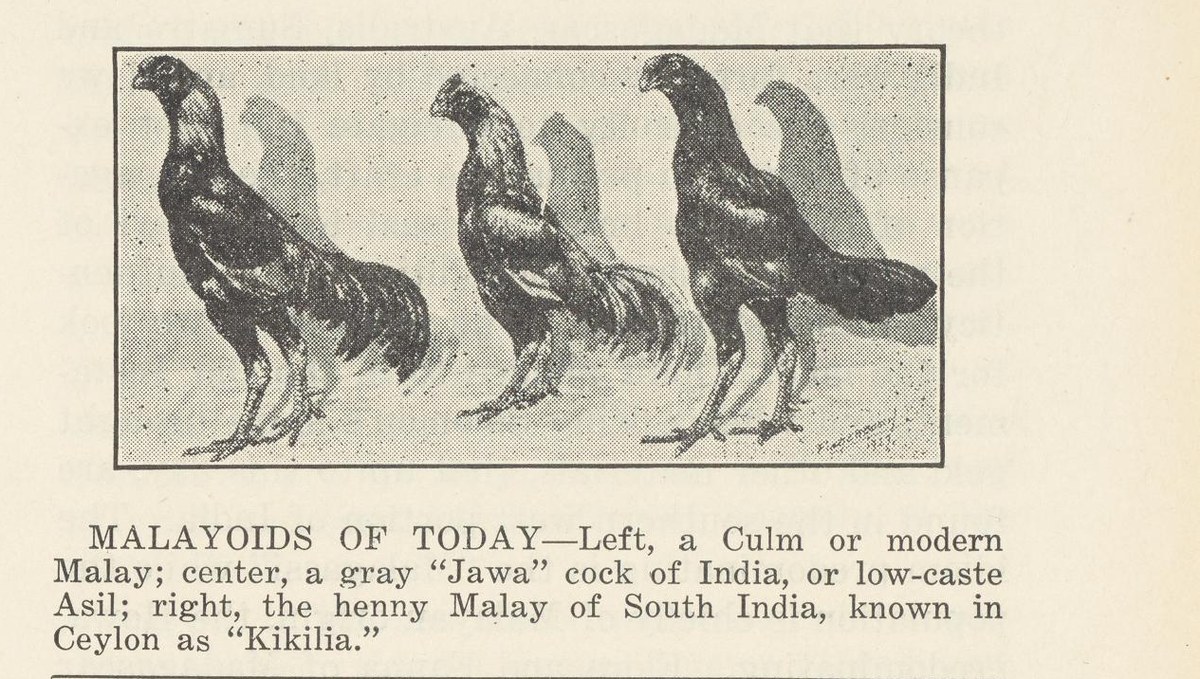
Page 243, Histories of Game Strains, 1928 · Cornell University Library
So the east has a real claim, and so does Spain, and so does England. The 1891 writer saw the eastern case and would not settle it. There is no verdict to issue here. Lay the accounts beside each other and draw your own conclusion — and notice that even the two writers who put the Kikilia on the map cannot agree whether it lives in South India or on Ceylon.
In America, the story splits in two.
Dr. J. W. Cooper, of West Chester, Pennsylvania, published Game Fowls, Their Origin and History in 1869. Through the 1860s, dealers had been selling a fowl they called the Henny Cock — solid black, with a satin gloss, sold as a pure breed or as an import. Cooper had seen enough of them:
“We believe them to be a fraud.”
— J. W. Cooper, M.D., 1869
He gave his cases. Judge Grant had a pretty black one, said to be pure, that ran when it was tested. A seven-pound “Mexican import” went, with a hen, to a Mr. Wingate of East Rochester, New Hampshire, and the chicks came in mixed colors. And in February 1869, a man who signed himself G. N. H., of Hamilton, Canada West, wrote in about his own. He had put his faith in the sire and watched him quit. His verdict:
“As good ordinary fighters as any man ever saw, but they are not game.”
— G. N. H., of Hamilton, Canada West, 1869
Cooper added that there were “many men in the United States, who have had the same confidence in the Henny Cock as the writer of the above.”
That is one fowl. The other, Cooper respected completely.
In a separate chapter, “Mexican Hen Cocks,” he described the Southern or Spanish Hen Feathers: 4 to 5½ pounds, with short sickles and a broad tail, “and hence the name hen cocks, or hen feather.” They came out of Mexico, Guatemala and the West Indies, and were found in Austin, New Orleans and Mobile. Cooper counted them game.
Read that description closely. Short sickles is not the same as no sickles. The Gulf Hen Feather that Cooper admired was not built quite like the English hen-cock, and not at all like the glossy black cock the dealers were selling.
Thirty years later the split was still on the page. C. L. Francisco’s The American Game Cock (Sayre, Pennsylvania, 1898) printed them as two separate plates — a Gray Henny Cock and a Mexican Hen Cock.
Whether the two were ever one family, nobody wrote down.
Not everyone shared Cooper’s doubts.
Gray, in 1878, wrote that the Henny Games were “imported from England and Spain at various times, and it is said to be very difficult to find them in their purity,” and that they “are said to be dead game.” Notice the “said to be,” twice. Gray was reporting what he had heard, not vouching for it.
Henry Flock did vouch — the same Flock who turns up in the Miner Blues story. His Breeders’ and Cockers’ Guide came out of Kansas City in 1889, and he was blunt about most things. On the Henny, he would not move:
“The Henney is not a freak of nature, but a distinct breed of fowls.”
— Henry Flock, Kansas City, 1889
He said it twice, spelled two different ways — “Hennys are a distinct breed of fowl” — and the line was still standing in the Chattanooga reprint of 1904.
Kansas City is also where the most human account comes from. In the 1928 Histories, a writer looked back more than thirty years to the nights, around 1894, when a Kansas City judge took him along — a boy of nine or ten — to see the fowl of that day. He remembered nearly all of it. One man he could never place:
“Another of that day I have long tried to remember, but without success. Night after night they would whip his Hennies, but his faith in them never faltered.”
— Unnamed writer, 1928 Histories, recalling Kansas City around 1894
Flock was writing in the same city in the same years. It is tempting to put the two men together. Nothing on paper does, and this page does not.
That is most of the Henny story in two sentences. A man who believed in the feather, and a name nobody kept.
The cock — Gray described him plainly in 1878:
“He closely resembles a hen in feather but not in size, and when pure never show any sickle feathers, and the hackle feathers of the neck are quite short, like those of the hen.”
— Gray’s Cocker’s Manual, 1878
The 1891 writer went further. The more “rounded, short and free from sheen or gloss” a cock is in hackle, cloak and tail, he said, the more he is “entitled to claim purity of breed.” Set that beside Cooper. The Henny Cock the dealers sold was known for its satin gloss. The best Henny man in England counted gloss against a cock.
Legs, eyes and beak — Atkinson’s standard gives them one line: “Henny—legs, eyes, and beak to match plumage.”
Colors — The 1891 writer listed dark partridge, red-grouse, wheaten, gray, black, dun, white and spangle. Gray found “all colors, some white, some Pile, some spangle.” Stoddard’s Book of Games (Hartford, 1886) called them Henny Games, “so called from having a tail like a hen, without sickle feathers, of various colors, the Whites perhaps being the best known,” and printed a plate of White Hennies.
Size. Cooper’s Hen Feathers ran 4 to 5½ pounds. The 1891 writer said his “generally run smaller, but sometimes weigh as much as seven or eight pounds.” Finsterbusch gave 7 to 9. The dealers’ Mexican import weighed 7. That is a wide spread for one family — wide enough that it may not be one family at all.
Style. The 1891 writer saw a “watchful eye, wary posture,” and thought that, like the Cheshire Piles, “they seem to have an hereditary style.” He believed their looks gave them an edge — that other cocks were “disconcerted by their feminine appearance and are unable to decide whether their mission is one of love or war.”
The faults. He was honest about those too. Hennies were “generally light in bone,” and never the old feeders’ first choice. They were “frequently found wanting in stamina,” which he took as “their further resemblance to hens in constitution as well as feather.” That is the best Henny man of his day telling you what to watch for in your own. It is worth more than any of the praise.
Hen feathering comes from one dominant gene, written Hf. It works in the skin.
In a hen-feathered cock, the skin around each feather follicle carries an enzyme called aromatase, which turns part of his male hormone into estrogen right where the feather grows. The follicle reads that as a hen’s signal and grows a hen’s feather. The rest of him never gets the message. Comb, spurs, station and crow are all cock.
The old proof was a skin graft. Skin taken from a Sebright — a bantam breed in which every cock is hen-feathered — and grafted onto another chicken went right on growing hen feathers. In the 1980s, researchers measured the higher estrogen activity in hen-feathered skin (study). In 2019, a study traced the switch to a piece of old retrovirus DNA sitting just ahead of the aromatase gene (study).
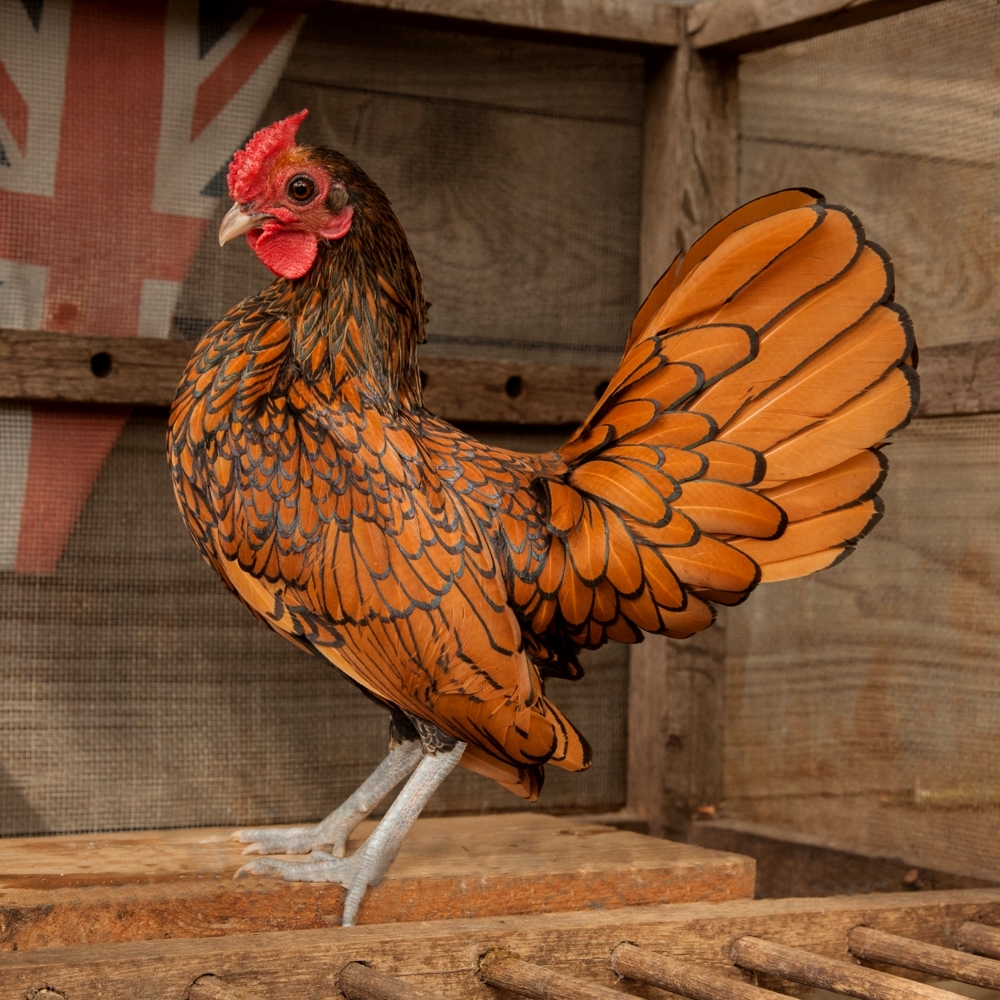
Gold Sebright. Every cock in this breed is hen-feathered. Photo: Latropox, CC BY-SA 4.0, via Wikimedia Commons
So the science sides with Finsterbusch on one point: the feather is not a degeneration. It is one small switch.
It also settles less than people want it to. The gene explains the feather. It does not explain the fowl. That is how Cooper could be right about the dealers’ Henny Cock and Flock could be right about his Hennies at the same time. Same feather. Different fowl.
Because Hf is dominant, one copy is enough to put the feather on a cock. A one-copy Henny over ordinary hens will throw about half his sons hen-feathered. A two-copy cock throws them all.
The daughters are where it hides. A hen looks the same with the gene or without it, because she is hen-feathered either way. About half the daughters of a one-copy cock carry it, and every daughter of a two-copy cock does. The only way to know which of your hens are carrying it is by the sons they throw.
That is how the feather slips out of a family quietly. Nobody culls it. It just stops being tracked, and a few generations later nobody is sure whether it is still in there.
It works the other way too. If a henny son turns up in fowl that have not shown the feather in years, you did not do anything wrong. It came through a hen, and it may have been riding along the whole time.
The 1891 writer thought the Hennies had held their type better than most, and he said why:
“having been kept more free from crosses than other strains of game, they retain the original characteristics of the breed.”
— “Game Cock,” in Atkinson, 1891
He called them “the most prolific layers of the whole game race,” and said they “probably carry more meat with less offal than any breed whatever.” What they lacked in ornament, he wrote, “they make up in utility, and for the use of the cottager or those who breed fowls for their own table they are worth all the new so-called best breeds.”
The cottager was a working countryman with a few fowl behind the house. That is where the best Henny man in England thought the family had been kept truest. It is also exactly the kind of yard that leaves no paper behind.
Every account above has the same hole in it. We know the feather. We know the counties, the ports and a handful of dates. What we almost never know is whose fowl they were, or what had been added to them.
The man in Kansas City kept faith in his Hennies night after night, in front of a boy who remembered everything else about those years. His name did not survive. The best Henny breeder in England did not even sign his own name to the chapter.
Henry Flock thought pedigree “cuts no figure; looks well on paper for some people.” He may have been right about the cock in front of him. He was wrong about what lasts. The feather has come down more than three hundred and fifty years. Almost none of the names that carried it have.
The biggest difference between peddled fowl and a well-maintained, well-documented family has never been the feather. It is whether anybody can tell you what they have, who they got them from, how long they have had them, and what has or hasn’t been added in the time they have been maintaining them.
With the Henny, that record matters more than it does with most families, because half of what the family carries does not show. The feather rides in the hens. The only way to keep track of it is to write down what they throw.
Bands are how you hold onto it — numbered, engraved with your farm name, in a range you control. Band your stags and pullets early, note which hens throw henny sons, and the record follows each chicken for life. The answer to “which of these hens carry it” ends up on the leg instead of in somebody’s memory.
This article is built on eight published sources, all public domain, and it says which one each claim comes from because they do not agree with each other:
J. W. Cooper, M.D., Game Fowls, Their Origin and History (West Chester, Pennsylvania, 1869), including the letters from G. N. H. and Marshall Wheeler, Esq. Gray, The Cocker’s Manual (Battle Creek, Michigan, 1878). Stoddard, The Book of Games (Hartford, 1886). Henry Flock, The Breeders’ and Cockers’ Guide (Kansas City, 1889; Chattanooga reprint, 1904). Atkinson, The Old English Game Fowl (London, 1891), with its Henny chapter by the writer signed “Game Cock.” C. L. Francisco, The American Game Cock (Sayre, Pennsylvania, 1898). Histories of Game Strains (Grit and Steel, Gaffney, South Carolina, 1928; chapters written 1927). And C. A. Finsterbusch, Cock Fighting All Over the World (1929).
The genetics section rests on the two published studies linked in the text.
Every quotation above comes from one of those books. Historical detail is reported as history, in the words of the men who wrote it, in past tense. Where a source is the only voice on a point, this page says so.
Every change to this page gets logged here with its date, including the ones that come from readers. If something here is wrong, say so. It gets fixed.
September 10, 2026 — First version.
Photographs: plate scans from the 1928 Grit and Steel volume, courtesy of the Cornell University Library / Biodiversity Heritage Library. Public domain. Gold Sebright: Latropox, CC BY-SA 4.0, via Wikimedia Commons.