
An Illinois family built out of a Welsh coal miner’s fowl by a storekeeper who wrote the whole thing down — and the one question the old man would never answer.
Beamology CNC · families & Bloodlines
Nick Vipond kept a saloon in the main part of Streator, Illinois — fifteen miles up the road from Cornell — and behind it he kept blue fowl. Dark blue, dark-eyed, dark-legged. He had them there from the 1870s until he quit business around 1917, and for the whole of that stretch men asked him what blood they were. He had one answer, and he gave it to everybody.
“They are my old Blues.”
— Nick Vipond, his answer to every man who ever asked, as recorded by Lloyd B. Miner in 1927
That was it. He never expanded on it, never wrote it down, and took whatever he knew with him. Most families lose their origin by accident — a man dies, a notebook goes in a box, nobody thought to ask. The Blues are one of the rare ones that lost it on purpose.
What we have instead is the next best thing, and honestly it may be better. One of the two young men Vipond taught sat down twenty-five years later and wrote the whole thing out himself — in the first person, with names and weights and dates — as a long letter to Grit and Steel that ran the following year in Histories of Game Strains. That man was Lloyd B. Miner of Cornell, Illinois, and the fowl carry his name because of what he did with them afterward.
Cornell around 1902 was a small place with a big appetite. A few half-mile running horses. A few scrub game fowl. One genuine hundred-yard-dash man. Covered wagon outfits came through every summer trading and racing horses, and professional foot racers traveled with them. There were saloons then. Miner’s own description of the village is that it would gamble on anything, and he does not say it as a criticism.
Seven or eight young fellows got into fowl about the same time. All of them quit but two: Miner, and his friend George Hasel. Hasel held on until about 1924, when work moved him from South Bend to Chicago to Denver and he had nowhere left to keep chickens.
Miner worked in his father’s store. Next door Ed Foley ran a hotel with a big back yard, and one day Miner noticed a beautiful blue-red rooster running loose in it with a few dunghill hens. He asked. Foley said the chicken wasn’t his — he was only walking him for Nick Vipond, over in Streator, fifteen miles off.
That is the entire origin of the family. A rooster in a hotel yard, and a young man who asked whose he was.
Vipond was born in Wales. He moved from Pennsylvania to Streator more than fifty years before Miner wrote that history — which puts it in the mid-1870s — and worked as a coal miner before he went into the saloon business. He brought fowl with him: very dark blue, dark eyes, dark legs.
Where those came from is the hole in the record and always will be. One account says imported from Ireland. Another says bought from a man back east who badly needed the money. Miner — who knew him better than anyone writing about him since — did not believe anybody actually knew, and said so.
The two young men went to Streator and each bought a rooster. Both were fought the next day. Both won. Then they kept going back.
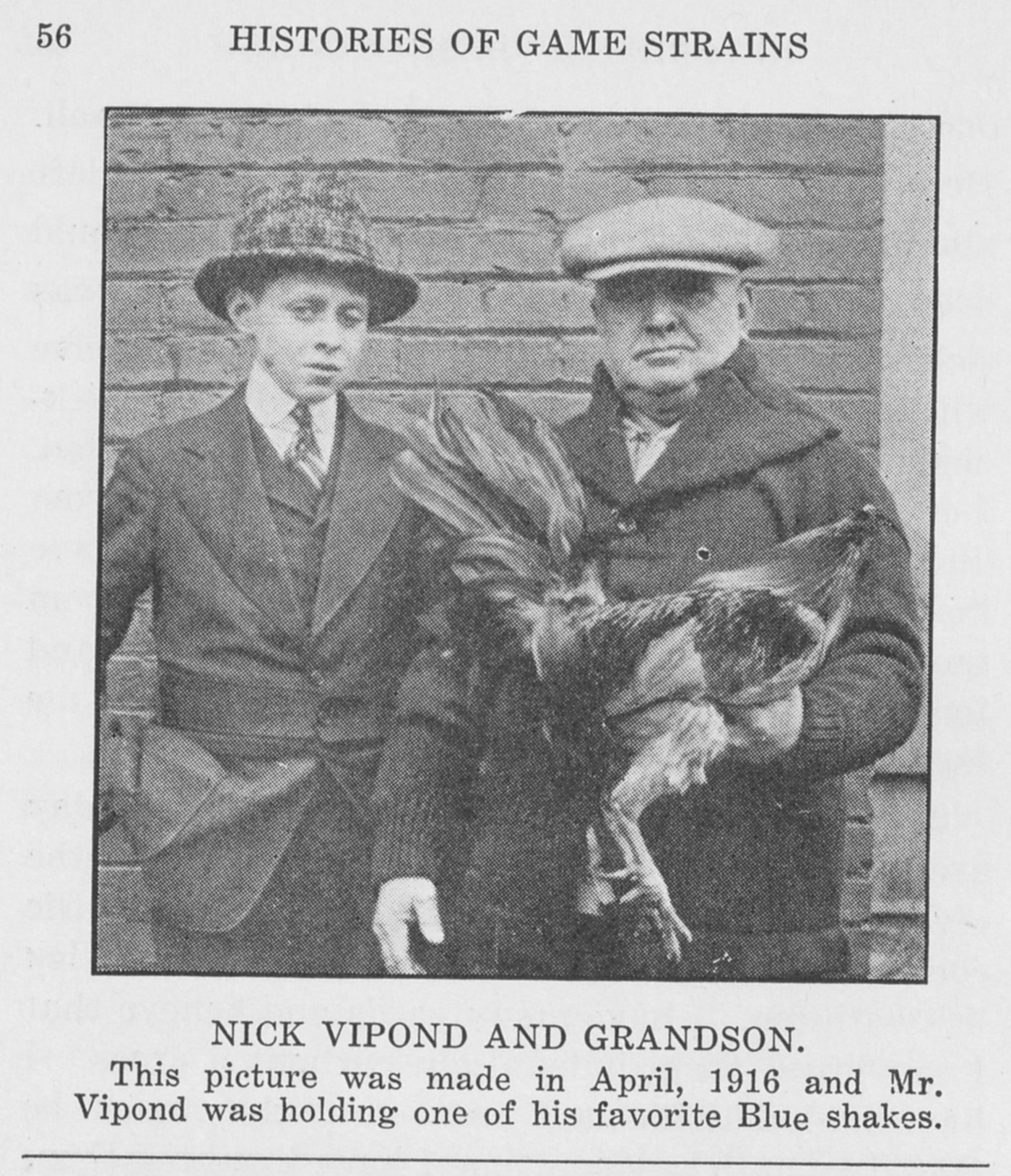
Page 56, Histories of Game Strains, 1928 · Cornell University Library
“We must have been awful pests to him and I often wonder how he had the patience to fool with us.”
— Lloyd B. Miner, 1927, on himself and George Hasel at Vipond’s place around 1902
He let them watch him work. Upstairs over the saloon in the winter, out in the barn at his house when it warmed up. He taught them how to hold a chicken and how to work one, and Miner said that to the end of his life he never saw another man who could put a rooster through his work without breaking a feather. He had a world of patience with a biting cock.
And then — this is the part that tells you Miner was writing honestly and not building a monument — he says he came to think the old man pulled his fowl too low to be at their best. Twenty-five years on, still grateful…still disagreeing.
Somewhere along the way Vipond put a white-legged, red-eyed light red rooster over some of his blue hens, and the yard changed. Inside a few seasons he had white-leg and yellow-leg Blues in every shade of lighter blue, and a good many light reds with white or yellow legs.
Miner asked him what the red rooster was. The answer was the same as always: he was just the same as the Blues. And Vipond added the one detail that makes the whole thing hang together — that some of them came red.
That is why the family throws blues, blue-reds and light reds out of the same pen to this day, and why none of it is evidence of a cross. It was there before Miner ever owned one.
This is the foundation, put together between about 1902 and the last main Nick Vipond ever fought. It is documented down to the ounce, which for a family this old is close to unheard of.
Miner bought a 4.14 white-leg red cock and six dark blue hens. Hasel bought a 5.04 dark-blue slip-leg cock and two dark blue hens.
Then Vipond quit, and did something the young men clearly never forgot. He gave each of them a rooster and told them exactly how to breed him.
To Hasel went the white-leg red 6.02 cock. Hasel had tried to buy that one before and been refused — Vipond would not put a price on him. Now he made him a present of him, because the young man had always wanted him so badly. He was to go over the pullets from the slip-leg blue.
To Miner went a young 5.08 dark-blue cock, one that had won a sensational battle in the main, to go over the pullets from the 4.14 red.
He never got a picture of the slip-leg, or of the old white-leg red that went to Hasel. But he had a photographer take a picture of the 4.14 Red, and he took a snapshot of the 5.08 Blue himself — and twenty-five years later he sent both in to the magazine to print, apologizing that his own was not clear.
Sit with that a second. In 1902, in a farm village in Illinois, a young man working behind the counter of a general store paid a photographer to make a record of a chicken.
The two of them bred those four cocks and eight hens exactly as they were told, and traded stags and pullets back and forth every year, mating more yards as they went — four yards to draw from between them, which is what made it work. One more rooster came in: Harry Rucker of Cornell had bought a three-times-winner brown-red white-leg cock from Nick and bred him on Dom hens; two years later Hasel bought that rooster off Rucker and put him over daughters of the slip-leg.
Four cocks, eight hens, one outside rooster, and two friends trading every season. That is the whole straight-comb family.
About 1917 Vipond quit business and moved to Chicago. He sold his fowl — all of them but three. Two large dark blue hens and one large white-leg hen. Those he would not sell to anybody.
He called on Miner a short time before he left and brought them over, and asked him to keep them. His daughter was sick, he said. He and his wife had to go and live with her, and there would be no place to keep chickens.
Miner kept them and bred them single-mated. Eleven years on, writing for Grit and Steel in 1927, he still had the letter Vipond had sent him from Chicago — asking him to have the hens caught up because he would be after them soon.
He never bred another chicken. He came once and took one of the blue hens for a friend, and gave Miner the other. The white-leg hen had died by then. Vipond moved on to Marion, then eventually back to Streator, and died there around 1924.
The Miner Blues as they stand descend from the four cocks and eight hens, the Rucker rooster, and three hens an old man could not bring himself to sell.
Every family has one brood cock that turns up on both sides of half the yards. For the Blues it was Old Blinker, and the way he got the name is the best-told scene in the whole account.
Miner gave Hasel a dark blue stag. Hasel put him over one of his white-leg red hens and got a white-legged blue-red stag out of the mating. He showed him in Chicago in 1919 against Sam Brazier, who had a wonderful stag of his own. Brazier’s stag cut him blind in one eye and broke one wing in the first pitting.
Hasel could hardly hold him through the rest.
Turned loose for the second pitting, with one eye and one wing gone, he went across like a flash and shuffled Brazier’s stag to death.
Hasel bred him that year and as a cock for two more, then in 1922 traded him back to Miner for a brood cock of Miner’s that had won several times. Miner bred Old Blinker until he died in the fall of 1924.
He was line-bred from the start, and Miner’s assessment is short: many of his yards carried more or less of Blinker’s blood on each side. He had raised plenty of good ones. He never found one that produced like that rooster.
The other name worth knowing from that era is Old White Leg, a four-times winner Miner raised himself — grandson of the 4.14 and of the old white-leg rooster of Vipond’s that started the color shift.
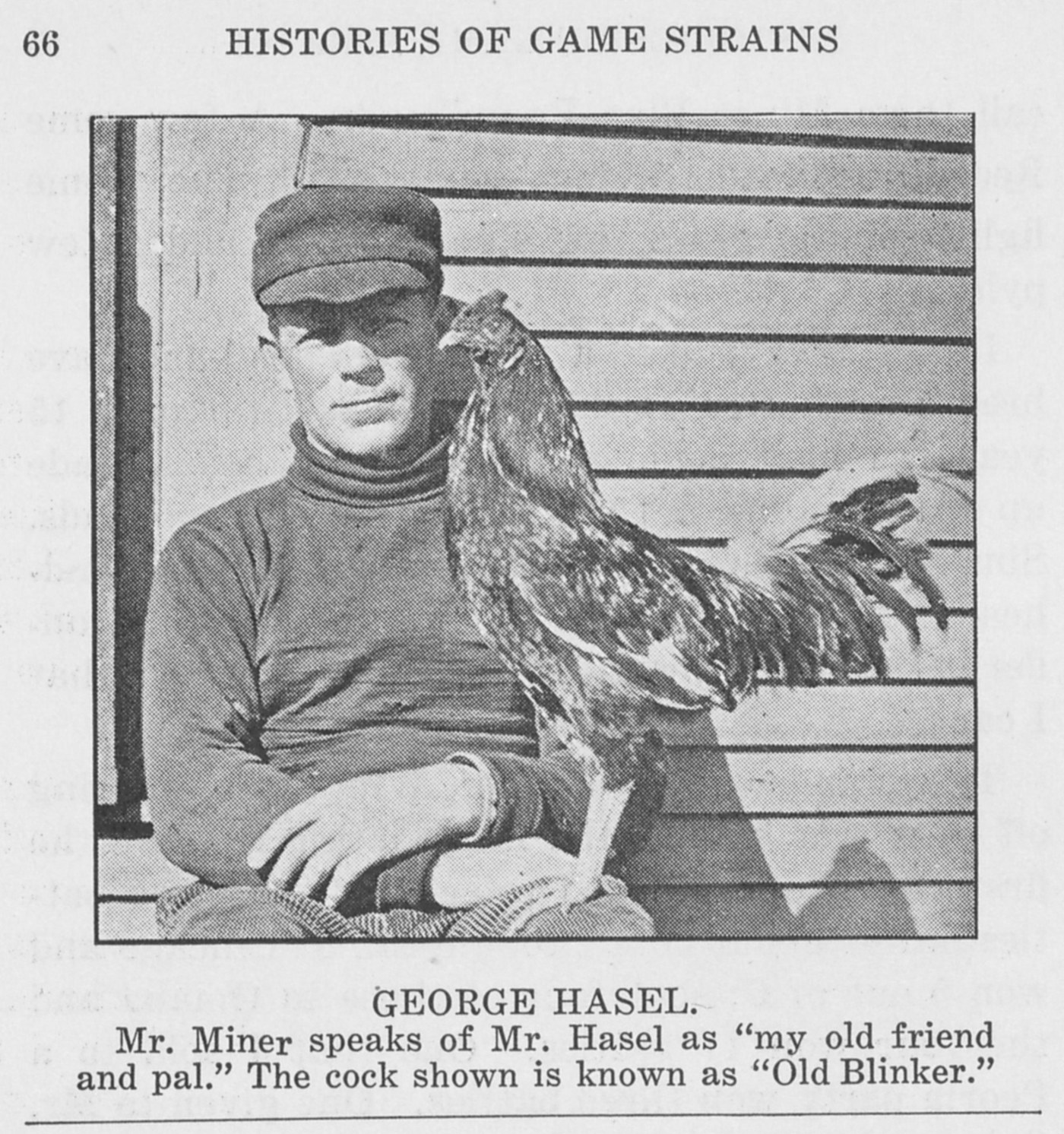
Page 66, Histories of Game Strains, 1928 · Cornell University Library
Miner kept a second family, entirely separate, all Roundhead blood. It came out of a friendship conducted almost entirely by mail.
Henry Flock of El Paso, Texas sent him a large blue pyle cock in 1920 along with some Flock Roundhead hens, with instructions to breed them together. Flock had the cock from Jas. G. Oakley of Ashby, Alabama. Miner bred them and sent stags back to Flock.
In 1922 Flock sent more hens and a little bright red rooster he called Broken Wing — pure Roundhead, mostly Flock blood, running back to old Dr. Saunders’ fowl. He came out of a chain Flock could recite from memory: bred by A. J. Jarrett of El Paso, out of cocks Flock had taken to El Paso and shown in Juárez, which had themselves been bred by a Mr. Wallace out of stock Flock sold him years before.
Broken Wing had won six times for Jarrett. He was shown three times in one night, and in the last of them got both wings broken, took some cutting, and was picked up and saved. Years later Miner ran into Jarrett at a main in Chicago and asked about him. Jarrett said he was a wonderful cock. Miner’s own verdict was shorter: he knew what he was as a brood cock.
That same year came a young blue pyle Roundhead cock with yellow legs, three yellow-legged blue-and-buff Roundhead hens and three solid blue hens with dark legs, all bred by Oakley and described as pure old-time Lundy Blues.
Flock sent full breeding instructions with them, down to which rooster went with which hens on which day. Miner says he followed his directions to the letter, and the two families he maintained afterward — a Broken Wing family and an Oakley family — are those instructions, held.
Flock died on 29 June 1924. Miner kept every letter the man ever wrote him, and his verdict on him is one sentence long.
“There never lived a better judge of a game cock nor a squarer man than Henry Flock.”
— Lloyd B. Miner, 1927. Flock died 29 June 1924.
Flock’s parting instruction was to line-breed Broken Wing with the Oakley hens. Then he added the line Miner quoted for the rest of his life — “Don’t look for any better fowl for if you do you look for the impossible.” (Henry Flock, in a letter to Miner.) Miner bred them in line from then on and said, plainly, that he believed the old man had told him the truth.
He shipped Flock young fowl for the last time in 1923, the year before he died.
Short, because the record is short and there is no reason to pad it.
He did not breed to color. That is stated flatly, and it is the most important trait note in the whole account — for twenty years color was allowed to fall wherever it fell, and only late did he start mating red to red and blue to blue, and then only when it cost him nothing else to do it.
Mostly blue-red or pyle Roundheads, a few red Roundheads. Hens solid blue — some light, some dark — a few blue-and-buff, a few pyle. Miner’s summary of how they went is four words long: clever, more aggressive than most Roundheads, dead game.
Worth reading, because it is a philosophy and not a recipe. Make the cross when you have time to test it, he says — not when you are forced into one and have to trust luck for a nick.
His method: show the halves first, breed the good ones back, then quarters, then eighths. And keep half, quarter and eighth-blood hens standing by even in the years he had no need of a cross at all.
He tried a Wisconsin Shuffler cock loaned to him by D. H. Pierce in 1917 — a dark-eyed brown-red. He tried to buy him. Pierce would not sell, and Miner handed him back in good shape in 1918. Two dark blue hens out of that cross were still strong brood hens at over nine years old. He tried a Smith Blue cross sent up from Texas in 1923. Hasel worked Gleezen Whitehackle and a Shawlneck hen from Elmer B. Denham onto the Blues, and the two friends traded the results back and forth as usual.
None of it displaced the family. It was insurance — tested in advance, then kept on the shelf.
He raised 200 to 400 young a year, with most of the brood yards at his house under his own eye and two farms to grow them out on, both with plenty of shade and running water. He was held pretty close in the general store, so the fowl got early mornings and late evenings.
He sold to the public for fifteen years and never had enough to fill the orders. And he says one thing about that which tells you more than the rest of the article put together: he often sold better stags than he kept for himself — and he was glad he could truthfully say so.
He also conditioned every one of them alone. Not out of secrecy. Because you learn things about a chicken working him that you will not learn any other way, and those are the things that tell you which ones to breed from.
That is the whole loop, stated plainly in his 1927 account: you show them to find out what you have, and what you find out is what you breed.
In 1918 Miner made a special request of his customers: report back on each cock. Some did, some didn’t. He kept the ones that came in through 1921 and then published the whole thing in Grit and Steel — including the losses.
Of 84 cocks and stags reported back to him:
153 battles in all — 116 won, 37 lost, in every length of heel.
Read that second-to-last line again. Nearly a third of the fowl he sold lost the first time out, and he printed it in the trade paper over his own name. Then he did it again with the Omaha letters a few years later: 114 battles from May 1924, 81 won, 33 lost, one draw — and he counted the draw.
And then, a few paragraphs on, the admission that ought to be the epitaph for a hundred years of this sport.
“I have never kept a complete record of all the battles my cocks have fought. It would have been almost impossible to do so.”
— Lloyd B. Miner, 1927
There it is. The most meticulous breeder in this whole story — the man who wrote down eight hens by weight, who kept a decade of another man’s letters, who paid a photographer to make a record of a rooster in 1902 — could not keep up with his own results once there were enough of them to matter.
He did not lose that record because he was careless. He lost it because he had no system that scaled.
Miner named them himself and explained exactly why, and it is the best answer anybody in this sport has ever given to the question. He calls them Miner Blues because most of them come blue…and because they have been bred by his method long enough to make them the type they are today.
Not because he originated them. He says outright that he did not. Because he maintained them, in one direction, for a quarter of a century.
He extended the same courtesy to his friend without hesitation. Hasel advertised and sold fowl out of that same foundation and called them Hasel Blues, and Miner’s position was that he had bred them long enough that he had every right to.
And then the line that ought to be nailed up in a good many yards.
“I have never spent much time in thinking up a name for my fowl as I feel sure that if cocks can fight they will make a name for themselves and if not a blood curdling name will not help them.”
— Lloyd B. Miner, 1927
The name has not disappeared. It still turns up in conversation among people who know fowl, still attached to Miner, a hundred years after a rooster stood loose in a hotel yard in Cornell. What nobody has laid out is the chain between then and now. If you have a piece of it, it belongs in the record.
Two men had the same fowl.
One of them answered every question about them with five words and took the rest to the grave. The other wrote down eight hens by weight, kept the letters, paid for the photographs, asked eighty-four customers how it went…and printed the answer when a third of it was bad.
There is a Miner Blues family. There is no Vipond Blues family.
The biggest difference between peddled fowl and a well-documented family has never been the blood. It is whether anybody can tell you what they have, who they got them from, how long they have had them, and what has or hasn’t been added in the time they’ve been maintaining them.
And that record is always the first thing to go. Miner lost his the same way everybody loses theirs — not to carelessness, but to volume. It goes when a good brood cock dies and nobody wrote down which hens he was over. It goes when a yard changes hands. It goes in one bad winter.
Bands are how you hold onto it. Numbered, engraved with your farm name, in a range you control — so the chicken and the record are the same object, and the answer to “which family is that” is on the leg instead of in somebody’s memory.
This article is built almost entirely on one source: Lloyd B. Miner’s own history of his fowl, written for Grit and Steel in 1927 and published the following year in Histories of Game Strains (Grit and Steel, Columbia, South Carolina, 1928). It is a first-person account by a man with an obvious interest in his own family, and nothing in it was ever independently corroborated. Where he is the only voice, this page says so. Historical detail from that account is reported as history, in his words, and is not a claim about anything living.
Every change to this page gets logged here with its date, including the ones that come from readers. If something here is wrong, say so. It gets fixed.
Photographs. Both plates on this page are from that 1928 volume, digitized by Cornell University Library for the Biodiversity Heritage Library. The book carries no copyright notice and is in the public domain.
8 September 2026 — First version.